
Table des matières (28)
Pragmata as a Cross-Platform Benchmark for Modern Upscaling
Pragmata is interesting less as a game and more as a clean test case for the current state of rendering technology across PC and consoles. It lands on almost every modern platform, uses the latest iterations of Capcom’s RE Engine, and leans heavily on upscaling and ray tracing to get a dense sci-fi aesthetic running at playable frame rates.
The result is a very clear comparison between NVIDIA’s DLSS on PC, Sony’s PSSR on PlayStation 5 Pro, and AMD’s FSR-based paths on the base consoles. Add the Nintendo Switch 2 port with its own DLSS pipeline and you get a full tour of what 2025-2026 rendering looks like in practice, not in vendor slides.
Feature Overview: What Each Platform Is Actually Doing
Before diving into image quality and performance, it helps to define the main variables Pragmata exposes:
- Internal rendering resolution – the “real” resolution the game draws before any reconstruction.
- Upscaling / reconstruction tech – DLSS, PSSR or FSR, each with different approaches to temporal data and antialiasing.
- Ray tracing and path tracing – optional on some platforms, absent on others, with big implications for GPU cost.
- Target frame rate – 30, 60 or >60 FPS, which drives how aggressive the above three knobs must be.
Pragmata pushes these knobs very differently on PC, on the three big living room consoles, and on Switch 2. That makes it a useful, concrete snapshot of where DLSS, PSSR and FSR are right now.
Specifications
Values above are approximate aggregates from technical testing, not hard guarantees. The important point is the relative strategy: NVIDIA hardware leans on DLSS and heavy ray tracing; PS5 Pro leans on PSSR to compensate for a low internal resolution; base consoles lean on older FSR-style upscaling; and Switch 2 uses DLSS mostly as a life raft for its limited power budget.
PC: DLSS With Ray/Path Tracing as the Reference Implementation
On PC, Pragmata is effectively built around NVIDIA’s ecosystem. A recent analysis with an RTX 5070 Ti shows the game offering several DLSS-related toggles:
- DLSS Super Resolution – reconstructs from lower internal resolutions to 1440p or 4K.
- DLSS Ray Reconstruction – replaces traditional denoisers for RT, especially in reflections and global illumination.
- Frame Generation (multi-frame) – inserts synthetic frames between real ones to boost the perceived FPS.
- Optional path-traced mode – extremely heavy, but a clean showcase for RT + DLSS.
Image Quality: DLSS Still Sets the Bar
In static shots, DLSS at a 1440p internal resolution reconstructing to 4K produces a sharper, more stable image than any console mode. Fine geometry on space station railings, hair strands, and small text on panels comes through with convincing detail and minimal shimmering.
Two factors drive this:
- Temporal data handling – DLSS uses motion vectors and history buffers with a relatively conservative approach to blending, which reduces ghosting on high-contrast moving objects.
- High-quality anti-aliasing baked in – the upscaler doubles as a temporal AA system, so you are not stacking a crude TAA pass on top of an upscaler.
Ray Reconstruction matters heavily in Pragmata’s interior scenes. With it enabled, reflection and GI noise settles much faster, producing smoother gradients on metallic walls and more stable reflections in glass and puddles. Compared to traditional RT denoisers, the improvement is visible during slow camera pans: less flickering in highly detailed reflections and fewer temporal smears.
Motion Handling and Artifacts
During rapid camera sweeps or strafing through cluttered corridors, DLSS maintains relatively clean edges on high-contrast geometry. Small light sources, cables and metallic grates remain stable, with limited “twittering” or crawling on diagonals. There is still some instability in particle-heavy scenes, but it is minor compared to what appears on FSR1-based console paths.
Frame Generation adds another dimension. Enabling it can roughly double the reported frame rate, but with latency implications:
- Perceived smoothness improves, especially in fast traversal sequences.
- Input latency increases, which is noticeable in tight combat scenarios for sensitive players.
- Combined with path tracing, frame generation is what makes the “full fat” RT preset borderline usable on mid-to-high-tier RTX hardware.
Overall, PC with RTX and DLSS remains the reference configuration for image quality. The gap narrows in hectic gameplay where attention is on enemies rather than fine geometry, but it never fully disappears. That is the benchmark that PSSR and FSR are implicitly competing with.

PS5 Pro: PSSR as the Best-Case Console Reconstruction
On PlayStation 5 Pro, Pragmata leans hard on Sony’s PSSR. Internal resolution in demanding RT modes reportedly drops as low as 864p, then PSSR reconstructs to a 4K output. On paper, this sounds drastic, but the reconstruction is competent enough that on a typical living-room TV, the drop is difficult to notice during normal play.
Sharpness and Detail vs DLSS
When comparing like-for-like scenes between DLSS at a modest internal resolution and PS5 Pro’s PSSR path, several patterns emerge:
- Static detail – Zoomed-in captures show DLSS retaining more sub-pixel detail. Fine railing geometry, micro-textures on suit fabric and tiny UI decals tend to look slightly blurrier or more smeared under PSSR.
- Edge stability – On moving edges (rotating mechanical parts, swinging cables), PSSR is more stable than FSR1 on base consoles but falls a bit behind DLSS, with occasional softer “wash” around small, fast-moving elements.
- Specular detail – In ray-traced reflections, DLSS + Ray Reconstruction preserves more fine highlights; PSSR’s reflections look solid, but often a step softer.
The important nuance: from a gameplay perspective, these differences are subtle at typical viewing distances. Technical pixel-peeping puts DLSS clearly ahead; practical viewing makes PSSR “good enough” in most situations, especially given that it is running from a much lower internal resolution on a fixed console.
Frame Rate Behaviour: 60 FPS RT on a Console
Pragmata’s RT performance mode on PS5 Pro is a useful demonstration of what PSSR enables. While base PS5 targets 60 FPS with a 1080p internal resolution and FSR-like upscaling, it sees drops and more frequent fluctuations in demanding scenes. On PS5 Pro, the combination of a stronger GPU block and more aggressive reconstruction allows:
- Stable 60 FPS targets in the RT mode in many corridor sequences.
- Occasional dips in cutscenes and effect-heavy set pieces, but less frequent and less severe than on base hardware.
- Additional high-refresh modes (up to 120Hz) with reduced visual settings for users with compatible displays.
Technical reviews note that in the most demanding “stress corridors”, PS5 Pro’s RT mode can even outpace base PS5 performance despite a lower internal resolution, purely because PSSR lets the GPU work with fewer pixels. PSSR is not free-it costs shader time-but the tradeoff is clearly favourable compared to brute-forcing a higher internal resolution with a cheaper upscale.
PS5 and Xbox Series X: FSR1-Style Upscaling as the Weak Link
On the base PS5 and Xbox Series X, Pragmata renders internally at around 1080p and then uses a rudimentary FSR1-like spatial upscaler to reach 4K output. This is the least modern part of the entire rendering lineup.
Noise, Shimmer and Temporal Stability
FSR1 is a spatial technique: it does not use temporal history or motion vectors in the way DLSS and PSSR do. In a heavily aliased scene with lots of micro detail and fine geometry, that matters.
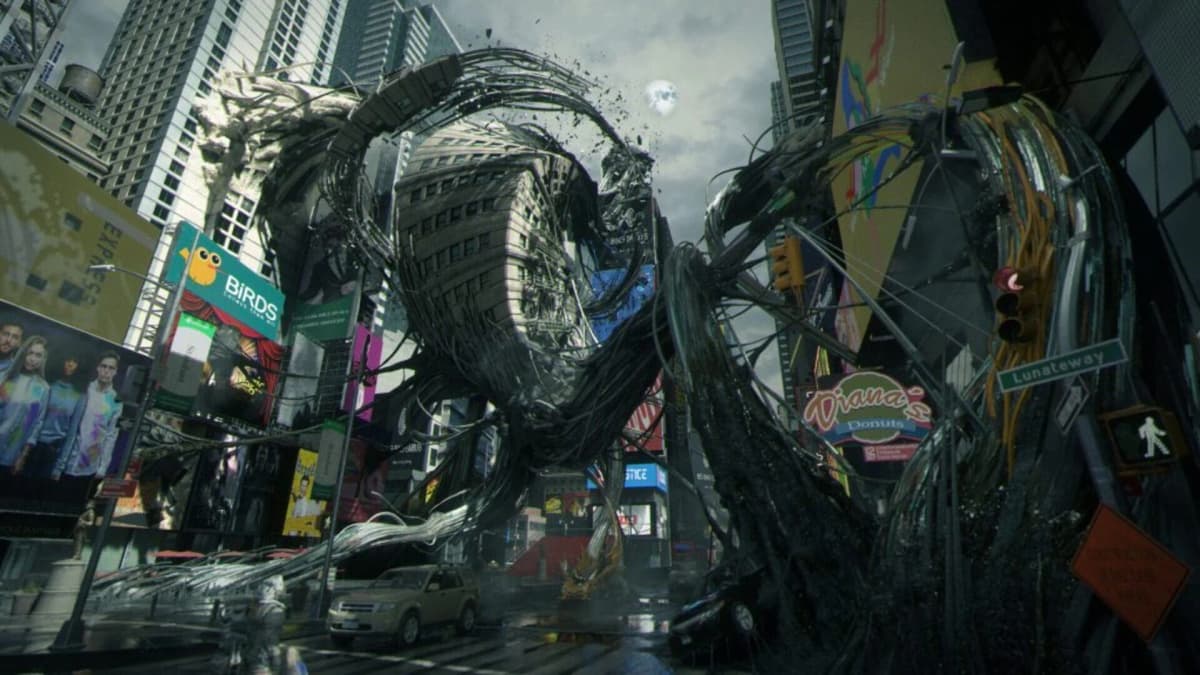
Specific artefacts observed on these versions include:
- Image noise in dense detail – metal grates, cable bundles and high-frequency textures look noisy, almost like a film grain overlay that the user cannot disable.
- Shimmering on movement – panning the camera across fences or diagonal struts reveals a crawling pattern as the upscaler struggles to resolve sub-pixel detail.
- Less coherent specular aliasing – small highlights on reflective surfaces break up more visibly, giving RT reflections a rougher, lower-precision look.
The underlying 1080p internal resolution is not inherently the problem; it is the combination of that internal resolution with a spatial upscaler that lacks temporal awareness. A temporal upscaler can trade spatial resolution for stability; a purely spatial one exposes the cost of that trade much more clearly.
Performance vs PS5 Pro
Despite the higher internal resolution compared to PS5 Pro’s 864p RT mode, base PS5 and Series X perform worse in heavy sequences. The GPU is spending more time on shading 1080p with RT and less on the actual upscaling, which is relatively cheap. Without PSSR-class reconstruction, they cannot drop their internal resolution as aggressively without the image collapsing.
This leads to a somewhat counterintuitive situation that shows up clearly in testing: PS5 Pro, rendering fewer internal pixels with a smarter upscaler, delivers both a cleaner image and more stable performance than the supposedly “same generation” base machines using an older upscaling path.
Xbox Series S: No Ray Tracing, Heavy Cuts
Xbox Series S represents the lowest-end living-room target. In Pragmata, that reality is uncompromising:
- No ray-traced reflections or GI.
- Significantly reduced asset quality and hair simulation compared to other consoles.
- Lower internal resolutions with the same basic FSR1-style upscaler.
- A focus on maintaining 60 FPS in most gameplay scenarios.
The upshot is a playable but clearly watered-down presentation. Without RT and with pared-back lighting, the strengths of DLSS and PSSR simply do not apply; there is no sophisticated temporal reconstruction to speak of. Series S functions here as a reminder that ambitious RT pipelines and cutting-edge upscalers carry real GPU demands that the smallest boxes cannot meet.
Nintendo Switch 2: DLSS as Performance Lifeline
The Switch 2 port of Pragmata is the most constrained version and a different kind of DLSS case study. Docked, it targets a 1080p output using DLSS, with internal resolutions hovering around 540p. In handheld, reports point to something closer to 360p reconstructed to the screen’s native resolution.
DLSS at Extremely Low Internal Resolutions
DLSS is clearly designed for higher internal baselines; feeding it ≈540p or especially ≈360p means there is far less raw information to reconstruct from. Nevertheless, relative to a naïve bilinear upscale, DLSS still provides:
- Cleaner edges on characters and larger geometry.
- Less obvious pixelation in mid-distance objects.
- Some temporal stability on moving elements, even if fine detail is lost.
that said, the compromises are obvious. Material quality, shadow maps, ambient occlusion and hair simulation are all dialed back. Outdoor scenes often run between 30–40 FPS with unlocked frame rates, and even interior scenes rarely hit a locked 60 FPS. DLSS here is not a route to parity with higher-end platforms; it is the reason the game runs at all.

DLSS vs PSSR vs FSR in Pragmata: A Functional Comparison
Pragmata exposes the strengths and weaknesses of each technology in a fairly neutral way. It is not a showpiece tuned for one vendor; it is a cross-platform product with common art assets and effects, leaving the reconstruction and RT stacks to do the heavy lifting.
Static Image Quality
In side-by-side captures:
- DLSS (PC, RTX) – highest detail preservation, best handling of fine geometry and texture detail, especially with Ray Reconstruction cleaning up RT noise.
- PSSR (PS5 Pro) – close behind in many scenes, especially at typical living-room distances; slight softness and loss of micro-detail compared to DLSS, but a clear step above FSR1 paths.
- FSR1-style upscaling (PS5/Series X/S) – visibly noisier and less stable, especially in dense geometry; looks acceptable in motion, but noticeably behind when paused or compared like-for-like.
- DLSS on Switch 2 – technically DLSS, but constrained by the very low internal resolution and heavy asset cuts; qualitatively below the other DLSS and PSSR implementations.
Temporal Stability and Motion
Temporal behaviour during gameplay is where perception actually forms, and where the ranking shifts slightly:
- DLSS – best overall stability in fast motion; some artefacts remain around alpha effects and particles, but edges and sub-pixel detail are more coherent than rivals.
- PSSR – in motion, the visible gap to DLSS narrows; many players will not spot the distinction without direct A/B comparison. It is still clearly ahead of FSR1 in flicker and shimmer control.
- FSR1-style – most affected by shimmering and noise during pans; temporal crawling on fine detail is practically a signature look at this point.
- DLSS on Switch 2 – motion is constrained more by variable frame rate and pared-down effects than by DLSS per se; reconstruction quality is adequate for a handheld but clearly not on par with high-end implementations.
Performance Trade-Offs
From a performance engineering perspective, Pragmata underlines a consistent pattern:
- Aggressive internal resolution cuts + high-quality temporal reconstruction (DLSS, PSSR) can deliver both higher performance and better subjective image quality than a more conservative internal resolution paired with a basic upscaler.
- Older spatial techniques (FSR1) limit how low you can push internal resolution before visual noise becomes unacceptable.
- Frame generation on PC can meaningfully multiply frame rate, but its latency penalties limit its suitability for highly reactive gameplay.
This sheds light on why PS5 Pro, despite its relatively modest hardware bump on paper, can outperform base consoles so convincingly in a game like Pragmata. PSSR is as important as the extra GPU compute; both are required to make 60 FPS RT even plausible.
✓ PROS
+
DLSS on PC delivers the cleanest, most detailed image, especially with Ray Reconstruction in RT scenes
+
PSSR on PS5 Pro enables 60 FPS RT with a surprisingly stable and sharp 4K output from low internal resolutions
+
DLSS-based Switch 2 port is playable despite extreme resolution cuts, demonstrating DLSS’s flexibility
+
Base console versions still offer RT and a 60 FPS target without completely collapsing image quality
✗ CONS
–
FSR1-style upscaling on PS5/Series X/S produces visible noise and shimmer, especially in motion
–
PSSR still trails DLSS for fine detail and specular precision on close inspection
–
Switch 2’s DLSS implementation is bottlenecked by very low internal resolution and heavy asset cuts
–
Frame generation on PC adds latency, making it an imperfect solution for all play styles
Practical Mode Choices by Platform
Technical analysis is useful, but Pragmata is still meant to be played. For users who want to set up once and avoid constant tweaking, the rendering behaviour suggests a few straightforward defaults.
PC (RTX GPUs)
- Use DLSS Quality or Balanced at 1440p or 4K output for best balance of sharpness and performance.
- Enable Ray Reconstruction if available; it meaningfully improves RT image quality.
- Enable Frame Generation only if you are comfortable with slightly higher latency or are playing less twitch-sensitive content.
- Reserve full path tracing for high-end GPUs; DLSS helps, but the raw cost remains significant.
PS5 Pro
- For most players, the 60 FPS RT performance mode with PSSR reconstruction is the target. It offers the best mix of image quality and responsiveness.
- 120Hz modes are valid for high-refresh displays but come with further reductions in fidelity; they are specialised options rather than defaults.
- The visual difference between PS5 Pro’s PSSR and PC’s DLSS exists, but in typical living-room conditions it is not dramatic.
PS5 and Xbox Series X
- Stick to 60 FPS performance modes if available; they manage a good compromise despite FSR1’s limitations.
- Avoid chasing visual parity with PS5 Pro or PC; the upscaler is the true limiting factor here, not just pure compute.
- Accept that some noise and shimmer are part of the trade-off; there is no settings tweak that fully fixes FSR1 artefacts.
Xbox Series S
- Prioritise performance over visual options. The absence of RT and lower asset quality are structural, not fixable via toggles.
- Expect a “good enough” experience rather than a showcase; this is the intended compromise on this class of hardware.
Nintendo Switch 2
- Accept variable performance, especially in open exteriors; the unlocked frame rate is part of the design.
- Docked, DLSS smooths things out enough to be playable on a TV, but the port is best understood as a handheld-first version.
- The DLSS badge here does not imply image quality comparable to PC or PS5 Pro; it is operating under far harsher constraints.
Conclusion: A Clear Hierarchy of Reconstruction Tech
Pragmata’s multi-platform rollout unintentionally doubles as a hierarchy chart for current reconstruction technologies. On one end sits DLSS on capable RTX hardware, pairing high internal resolutions with advanced temporal logic and Ray Reconstruction for RT workloads. Just below that is PSSR on PS5 Pro, showing that a well-designed console-side solution can get close to DLSS in motion, while enabling 60 FPS RT at surprisingly low internal resolutions.
Below those, FSR1-style upscaling on base PS5 and Series X exposes the limitations of older, mostly spatial techniques. It keeps the game running at acceptable frame rates, but with a clear and persistent cost in noise and stability that newer methods have largely solved. Series S and Switch 2 demonstrate the lower bound of what can be kept running with aggressive upscaling and reduced fidelity.
The technical takeaway is straightforward: modern temporal reconstruction like DLSS and PSSR does not just rescue performance, it often produces a better subjective image than higher native resolutions filtered through basic upscalers. Pragmata makes that visible across an entire device family, from handhelds to high-end PCs, with very few variables changed beyond the upscalers themselves.
8/10 (as a tech showcase)
VERDICT
Pragmata is one of the clearest current case studies for how DLSS, PSSR and legacy FSR-class upscalers differ in practice. DLSS on PC remains the quality benchmark, PS5 Pro’s PSSR delivers a surprisingly strong console implementation that enables 60 FPS ray tracing, and base-console FSR paths now look distinctly last generation by comparison.